Skip to content

Published science

The foundational validation study

Hearing tests are just child's play: the Sound Scouts game for children entering school

Harvey Dillon, Carolyn Mee, Cuauhtemoc Moreno & John Seymour National Acoustic Laboratories & Sound Scouts, Sydney International Journal of Audiology, 2018 (opens in new tab)

Why this source matters: this study was published in the field's leading peer-reviewed journal, meaning its methodology and results were reviewed by independent experts before publication. The test itself was developed with the National Acoustic Laboratories, the research arm of Hearing Australia.

Objective: To create a hearing test usable without the involvement of a clinician or calibrated equipment, suitable for children aged 5 or older.

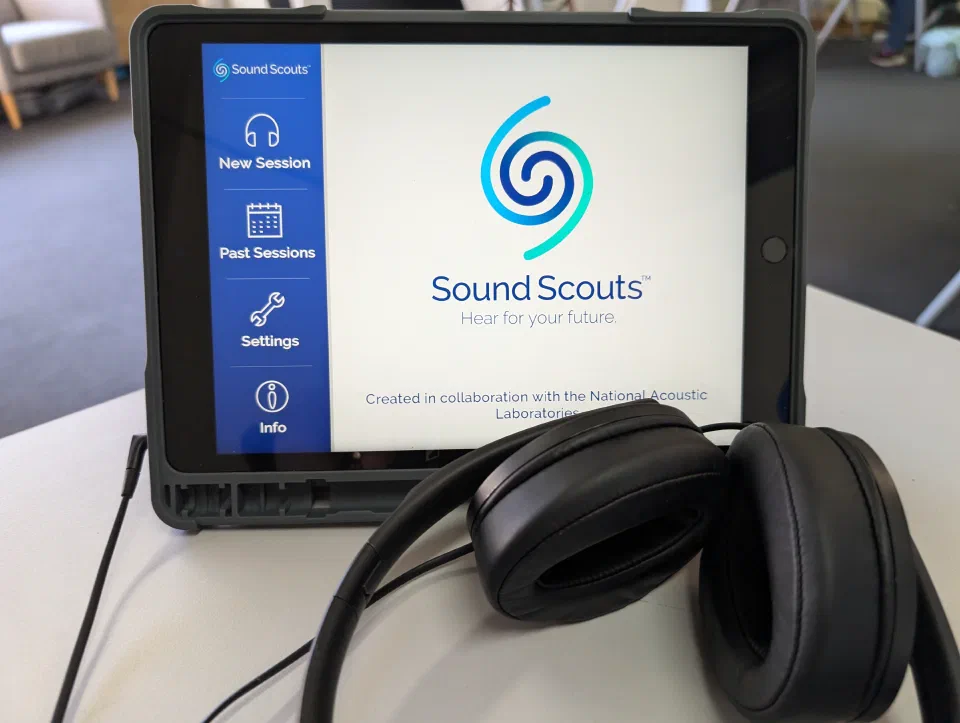
Design: The touch screen based app includes a test of speech in quiet, speech in noise and tones in noise, all embedded in a game designed to maintain engagement. Data was collected to intelligibility-equalise the stimuli, establish normative performance, and evaluate the sensitivity with which Sound Scouts detected known hearing problems and identified their type.

Study sample: Children aged 5 to 14 (394 with normal hearing, 97 with previously identified hearing loss) and 50 adults with normal hearing.

Results: With pass–fail criteria set such that 98% of children with normal hearing passed, 85% of children with hearing loss failed Sound Scouts. No child with four-frequency average hearing thresholds of 30 dB HL or greater in their poorer ear passed.

“Sound Scouts has specificity and sensitivity sufficiently high to provide hearing screening around the time children typically enter school.”

Read the full study  (opens in new tab)

Independent evaluations

What other researchers found

Evaluation of a game-based hearing screening program for identifying hearing loss in primary school-aged children

Patrick Bowers, Kelley Graydon & Gary Rance University of Melbourne International Journal of Audiology, 2022 (opens in new tab)

Synopsis: Sound Scouts was tested at scale across a real school screening program, noisy classrooms and ordinary tablets, not laboratory conditions.

Extract: 111 children (8.84%) presented with evidence of middle/outer ear pathologies… The false positive rate was 5.01%, indicating that a relatively small proportion of the children who failed the screenings were subsequently shown to have normal auditory function.

Detection of hearing problems in Aboriginal and Torres Strait Islander children: a comparison between clinician-administered and self-administered hearing tests

Kiri Mealings, Samantha Harkus, Brooke Flesher, Alea Meyer, King Chung & Harvey Dillon National Acoustic Laboratories & Australian Hearing, Sydney International Journal of Audiology, 2020 (opens in new tab)

Synopsis: Self-administered Sound Scouts results compared directly against clinician-administered audiometry in Aboriginal and Torres Strait Islander communities, which are populations with the highest rates of childhood ear disease in Australia.

Extract: Acceptable threshold differences of ≤5 dB between AutoAud and manual audiometry hearing thresholds were found for 88% of thresholds… Consistent pass/fail results on the Sound Scouts speech-in-quiet measure and manual audiometry were found for 81% of children.

Speech-in-noise recognition as a predictor of academic achievement

Dani Tomlin, Patrick Bowers, Benjamin Zonca, Kelley Graydon, Jocelyn Phillips & Gary Rance University of Melbourne PLOS ONE, 2025 (opens in new tab)

Synopsis: 108 primary school children completed Sound Scouts listening assessments and NAPLAN tests. Speech-in-noise ability, a skill Sound Scouts measures, proved a significant predictor of reading outcomes.

Extract: A significant interaction between speech-in-noise ability and reading was seen in the combined cohort… This research has implications for early hearing screening programs, teaching approaches, and interventions focused on enhancing the learning environment for all students.

Cost-Effectiveness of Screening a 5 Year Old Child for Hearing Loss Using Sound Scouts Compared with no Screening: A Decision Model Analysis

M. Gumbie, B. Parkinson, R. Bowman, R. Song & H. Cutler Value in Health, 2018 (opens in new tab)

Synopsis: Independent health-economics analysis modelling the cost per quality-adjusted life year gained from screening a five-year-old with Sound Scouts versus no screening.

Extract: This resulted in an ICER of around A$4,472 per QALY gained, which is likely to be considered cost-effective… screening with Sound Scouts has a 95% probability of being cost-effective using a threshold of A$60,000 per QALY.

Validity and reliability of an automatic audiometry application for iOS iPads with consumer-grade headphones

Azza Al-Maskari, Vinayak Hulihalli, Reza Hoseinabadi, Harvey Dillon, Carolyn Mee & Kevin J. Munro Macquarie University & University of Manchester International Journal of Audiology, 2025 (opens in new tab)

Synopsis: Investigation of the validity and reliability of the Sound Scouts Automatic Audiometer application and derivation of Equivalent Sound Pressure Level (ETSPL) values for Sennheiser HD 300 headphones.

Extract: Automatic audiometer hearing thresholds were easy to obtain and agreed closely with conventional audiometry.

Beyond peer review

Quality Managed

Sound Scouts is registered with the Therapeutic Goods Administration as a Class IIa medical device (ARTG 501132). Class IIa registration requires an independent assessment of safety and clinical performance.

View the public ARTG summary (opens in new tab)