DDdT
Dichotic digits difference test
Appropriate for age 7 and over
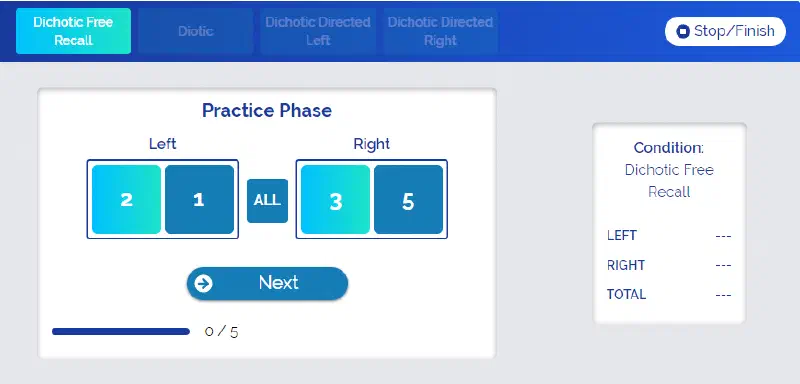
The DDdT test presents different digit names (one to ten, excluding seven) to each ear simultaneously under headphones. Each trial consists of two digits presented sequentially to each ear. Its two conventional test modes are:
- Free recall, in which the client reports all four digits presented; and
- Directed left and directed right, in which the client reports only the two digits presented to the directed ear.
DDdT differs from other dichotic digit tests in that also includes a control condition in which the stimuli are presented diotically (i.e. same sounds to both ears). Although the diotic condition shares many response demands with the usual dichotic tasks, there is nothing dichotic about the stimulus, so a score below the normal range in both the dichotic and diotic conditions may indicate that the cause does not originate from a problem with dichotic processing of sounds. Possibilities of such a result include deficits in memory, attention, or an auditory processing disorder that decreases the effectiveness with which any two simultaneously present sounds can be separated. Alternatively, a poor result in the diotic condition may indicate that the signals sent to the brain by each may be interfering with each other, despite originating from the same sounds. The DDdT expresses all scores relative to the extensive normative data built into the software. This includes the derived scores of right-ear advantage, and dichotic advantage (i.e. dichotic score relative to diotic score).
Published Science
Cameron, S., & Dillon, H. (2020). Are “Dichotic” Deficits Uniquely Dichotic? Investigating Dichotic Performance with the Dichotic Digits Difference Test (DDdT) in a Large Clinical Population of Children Referred for an Auditory Processing Assessment. Journal of the American Academy of Audiology, 31(3), 233–242. https://pubmed.ncbi.nlm.nih.gov/32119818/
Cameron, S., Glyde, H., Dillon, H., Whitfield, J., & Seymour, J. (2016). The Dichotic Digits difference Test (DDdT): Development, Normative Data, and Test-Retest Reliability Studies Part 1. Journal of the American Academy of Audiology, 27(6), 458–469. https://pubmed.ncbi.nlm.nih.gov/27310404/
Cameron, S., Glyde, H., Dillon, H., & Whitfield, J. (2016). Investigating the Interaction between Dichotic Deficits and Cognitive Abilities Using the Dichotic Digits difference Test (DDdT) Part 2. Journal of the American Academy of Audiology, 27(6), 470–479. https://pubmed.ncbi.nlm.nih.gov/27310405/

Test your child's hearing today
The Sound Scouts app takes under 10 minutes and requires no clinic visit.
Learn about Sound Scouts